





We've compared the different positions of the European Commission, Council of the EU and the European Parliament on the review of the SFDR. Read below our recommendations for this trilogue.
Trilogue negotiations on the SFDR review are due to start on 22 October and envisioned to finish by the end of 2026.
Parliament's text is the strongest of the three on most issues. Its main weakness is ESG Basics: retail investors receive a single indicator on fossil fuel exposure and little other information from which to assess performance, which risks perpetuating the catch-all character of Article 8 under SFDR 1.0.
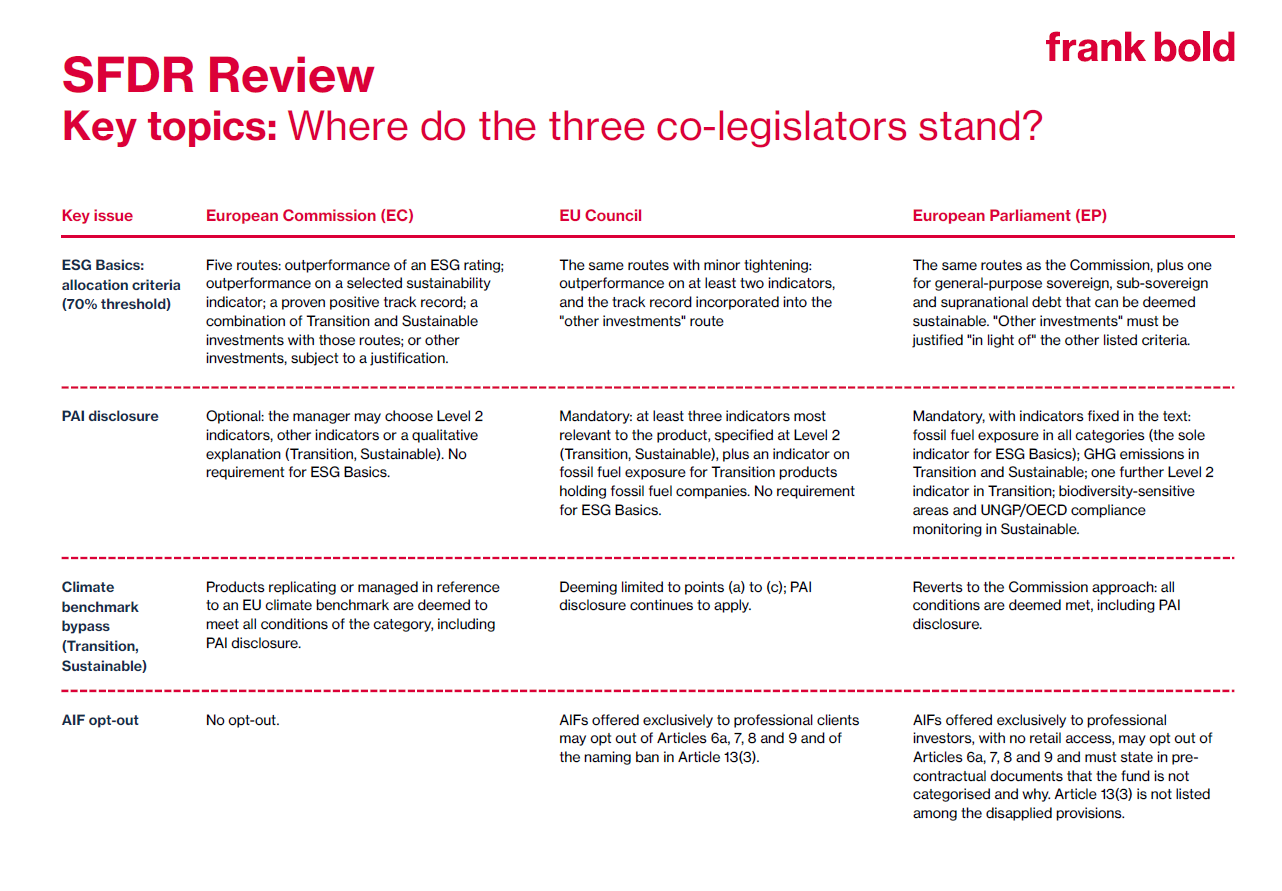
Below, we set out our three priorities for the trilogue and the specific solutions we recommend to address them.
Parliament requires a single indicator for ESG Basics, exposure to the fossil fuel sector, and this must be retained. We ask that Parliament's own Transition wording be applied to Article 8, so that ESG Basics products report GHG emissions and fossil fuel exposure, together with one further indicator selected for relevance. This corresponds to the three indicators required by Council for Transition and Sustainable.
Council limits the effect of safe harbour to points (a) to (c) of the first subparagraph, so that PAI disclosure under point (d) continues to apply to products using the bypass. Parliament deems all conditions met. We ask the co-legislators to support the Council's scope.
The Commission proposal contains no opt-out, and we ask the co-legislators to maintain this position. If an opt-out is retained, Parliament's version is preferable to Council's, because it requires that no retail investor has access to the fund and requires a pre-contractual statement of non-categorisation.

Czech Supreme Administrative Court ruled yesterday in favour of air quality and protection of human health. In the case local citizens and an NGO from Ostrava agglomeration, the most polluted region in the Czech Republic, succeeded with their claim for better air quality.
Yesterday, on 5 November 2018, a lawsuit against the Ministry of the Environment (MoE) on liability for health damages and death of her husband from lung cancer was filed with the District Court in Prague 10. The plaintiff seeks damages for lung cancer, which she has managed to cure, but her husband has succumbed to the illness in October. The cause of the disease is seen in the long-term excessive concentration of air pollutants at their place of residence in Ostrava-Radvanice and in the fact that the MoE failed to provide effective measures to decrease the pollution to legal limit values.
The Brussels office of the public interest law firm Frank Bold is currently recruiting a Research Intern to start full-time in January 2017 for a period of four to six months.


