





We've compared the different positions of the European Commission, Council of the EU and the European Parliament on the review of the SFDR. Read below our recommendations for this trilogue.
Trilogue negotiations on the SFDR review are due to start on 22 October and envisioned to finish by the end of 2026.
Parliament's text is the strongest of the three on most issues. Its main weakness is ESG Basics: retail investors receive a single indicator on fossil fuel exposure and little other information from which to assess performance, which risks perpetuating the catch-all character of Article 8 under SFDR 1.0.
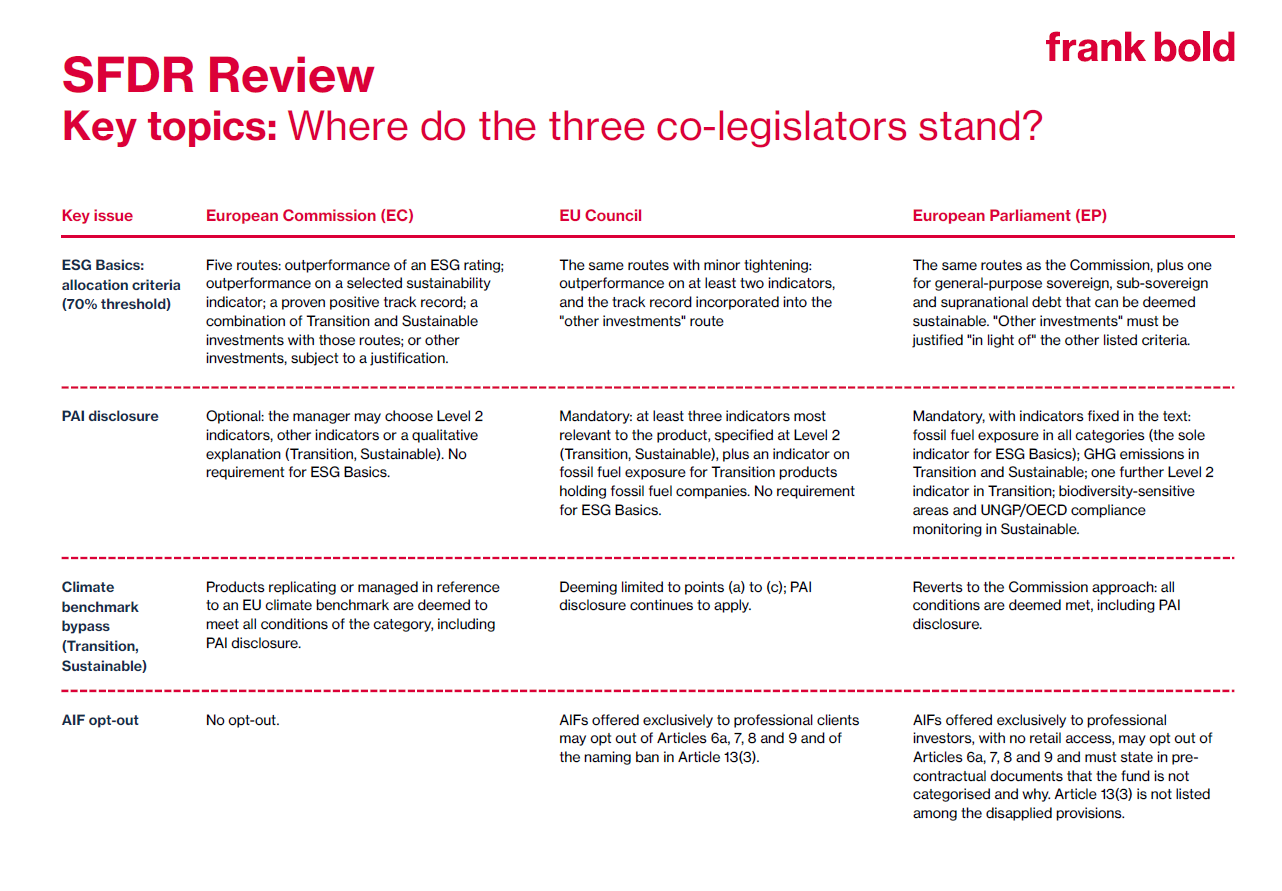
Below, we set out our three priorities for the trilogue and the specific solutions we recommend to address them.
Parliament requires a single indicator for ESG Basics, exposure to the fossil fuel sector, and this must be retained. We ask that Parliament's own Transition wording be applied to Article 8, so that ESG Basics products report GHG emissions and fossil fuel exposure, together with one further indicator selected for relevance. This corresponds to the three indicators required by Council for Transition and Sustainable.
Council limits the effect of safe harbour to points (a) to (c) of the first subparagraph, so that PAI disclosure under point (d) continues to apply to products using the bypass. Parliament deems all conditions met. We ask the co-legislators to support the Council's scope.
The Commission proposal contains no opt-out, and we ask the co-legislators to maintain this position. If an opt-out is retained, Parliament's version is preferable to Council's, because it requires that no retail investor has access to the fund and requires a pre-contractual statement of non-categorisation.

Czech Supreme Administrative Court ruled today in favour better protection of human health from air pollution in Brno, a Czech city with 370 thousand inhabitants. The Court revoked the city's Air Quality Management Plan, issued in 2016 by the Czech Ministry of Environment. The reasoning of the ruling has not been made public yet, but the main argument against the plan was that it was not effective enough and would not lead to a swift achievement of the binding air quality standards. A similar ruling was issued in December 2017 with respect to Ostrava and in February 2018 regarding Prague and Usti region.
Czech Supreme Administrative Court ruled yesterday in favour better protection of human health from air pollution in Usti region on the northern border of the Czech Republic. The Court partially revoked the region's Air Quality Management Plan, issued in 2016 by the Czech Ministry of Environment.
Prague Municipal Court ruled today in favour better protection of human health from air pollution in the capital of the Czech Republic. The Court revoked most of Prague's Air Quality Management Plan, issued in 2016 by the Czech Ministry of Environment.


