





We've compared the different positions of the European Commission, Council of the EU and the European Parliament on the review of the SFDR. Read below our recommendations for this trilogue.
Trilogue negotiations on the SFDR review are due to start on 22 October and envisioned to finish by the end of 2026.
Parliament's text is the strongest of the three on most issues. Its main weakness is ESG Basics: retail investors receive a single indicator on fossil fuel exposure and little other information from which to assess performance, which risks perpetuating the catch-all character of Article 8 under SFDR 1.0.
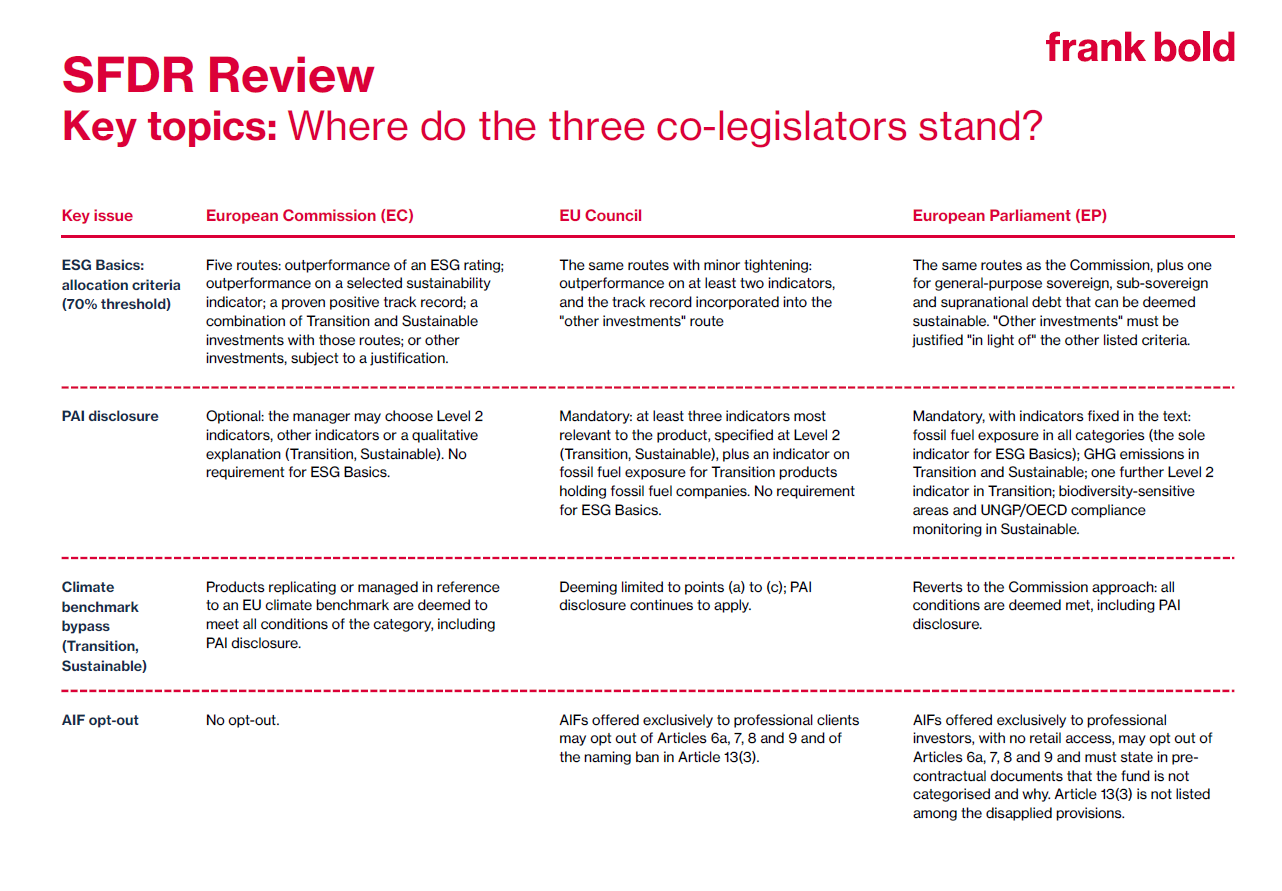
Below, we set out our three priorities for the trilogue and the specific solutions we recommend to address them.
Parliament requires a single indicator for ESG Basics, exposure to the fossil fuel sector, and this must be retained. We ask that Parliament's own Transition wording be applied to Article 8, so that ESG Basics products report GHG emissions and fossil fuel exposure, together with one further indicator selected for relevance. This corresponds to the three indicators required by Council for Transition and Sustainable.
Council limits the effect of safe harbour to points (a) to (c) of the first subparagraph, so that PAI disclosure under point (d) continues to apply to products using the bypass. Parliament deems all conditions met. We ask the co-legislators to support the Council's scope.
The Commission proposal contains no opt-out, and we ask the co-legislators to maintain this position. If an opt-out is retained, Parliament's version is preferable to Council's, because it requires that no retail investor has access to the fund and requires a pre-contractual statement of non-categorisation.

Organisations involved with the European Financial Reporting Advisory Group (EFRAG) express their deep concern over the European Commission's proposal to exempt asset management from the revised European Sustainability Reporting Standards. Read our joint letter below.
A new legal briefing by Frank Bold unpacks the new restrictions on information requests to business suppliers following the Omnibus 1 revisions to the CSRD and CSDDD, and explains the practical implications for companies.
Due diligence under the Corporate Sustainability Due Diligence Directive (CSDDD) is designed to direct finite corporate resources towards the issues that matter most for people and the environment. At the heart of that effort is prioritisation, defined in Article 9 of the Directive. Having spoken about this topic at the RBA conference this week, I want to share some reflections on what good prioritisation looks like in practice and what pitfalls to avoid.


