





We've compared the different positions of the European Commission, Council of the EU and the European Parliament on the review of the SFDR. Read below our recommendations for this trilogue.
Trilogue negotiations on the SFDR review are due to start on 22 October and envisioned to finish by the end of 2026.
Parliament's text is the strongest of the three on most issues. Its main weakness is ESG Basics: retail investors receive a single indicator on fossil fuel exposure and little other information from which to assess performance, which risks perpetuating the catch-all character of Article 8 under SFDR 1.0.
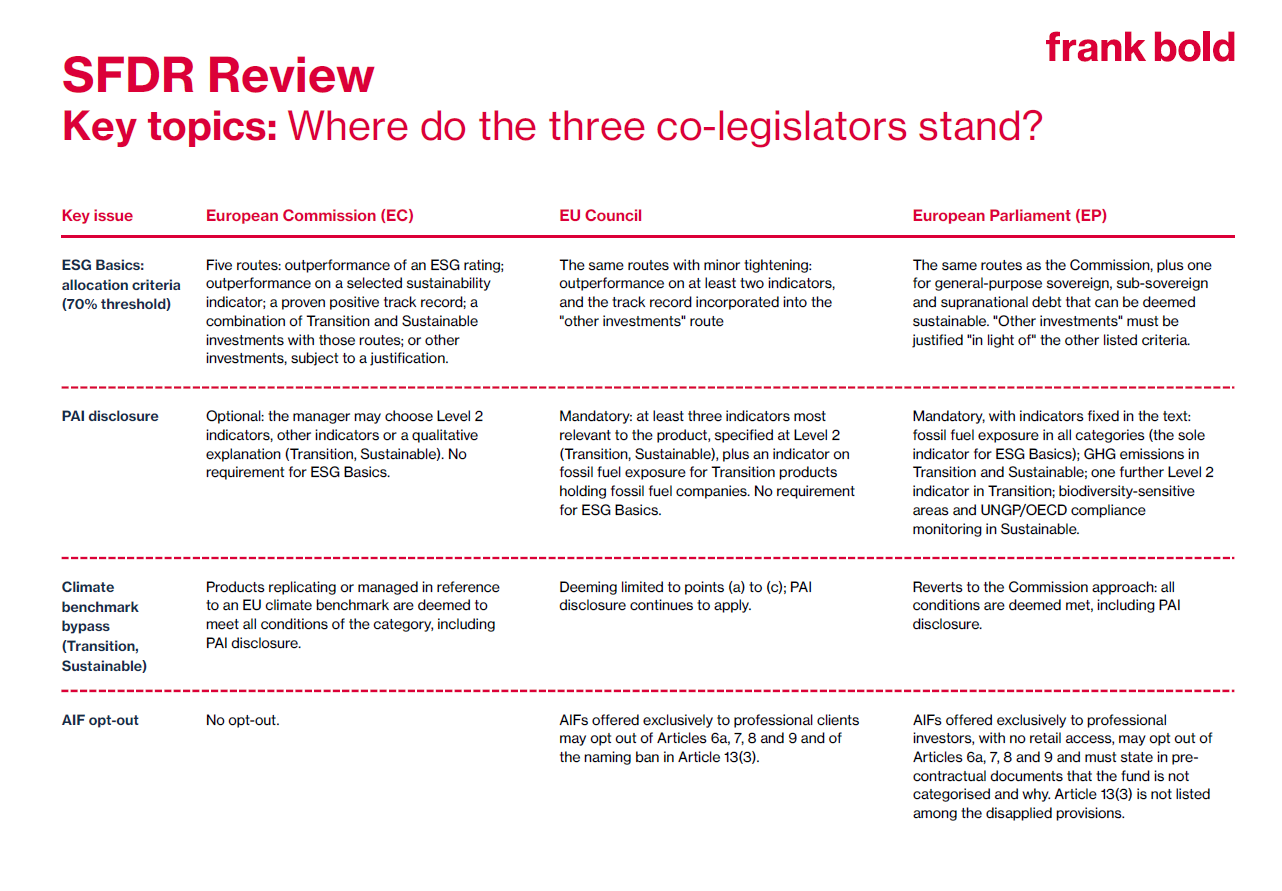
Below, we set out our three priorities for the trilogue and the specific solutions we recommend to address them.
Parliament requires a single indicator for ESG Basics, exposure to the fossil fuel sector, and this must be retained. We ask that Parliament's own Transition wording be applied to Article 8, so that ESG Basics products report GHG emissions and fossil fuel exposure, together with one further indicator selected for relevance. This corresponds to the three indicators required by Council for Transition and Sustainable.
Council limits the effect of safe harbour to points (a) to (c) of the first subparagraph, so that PAI disclosure under point (d) continues to apply to products using the bypass. Parliament deems all conditions met. We ask the co-legislators to support the Council's scope.
The Commission proposal contains no opt-out, and we ask the co-legislators to maintain this position. If an opt-out is retained, Parliament's version is preferable to Council's, because it requires that no retail investor has access to the fund and requires a pre-contractual statement of non-categorisation.

The Parliament proposal shows that many of the concerns raised through Frank Bold’s research and engagement with policymakers are now entering the legislative mainstream. But the negotiations ahead will determine whether the final framework is capable of addressing the structural weaknesses that continue to undermine trust in the sustainable investment market.
The European Commission has published its draft Delegated Regulation revising the European Sustainability Reporting Standards (ESRS). The revision follows the Omnibus I Simplification Package and is presented as a burden-reduction measure. Some of it is - but a closer reading reveals a set of changes that go well beyond simplification, departing from EFRAG's technical advice and disregarding formal recommendations from the European Supervisory Authorities. Many of these changes have significant implications for the quality and comparability of sustainability data available to the market and public.
By approaching sustainability strategically, companies can turn corporate reporting into a powerful tool to identify their exposure to climate and social risks in their value chains, future-proof the resilience of their business model and build trust with investors, customers and partners alike.


