





We've compared the different positions of the European Commission, Council of the EU and the European Parliament on the review of the SFDR. Read below our recommendations for this trilogue.
Trilogue negotiations on the SFDR review are due to start on 22 October and envisioned to finish by the end of 2026.
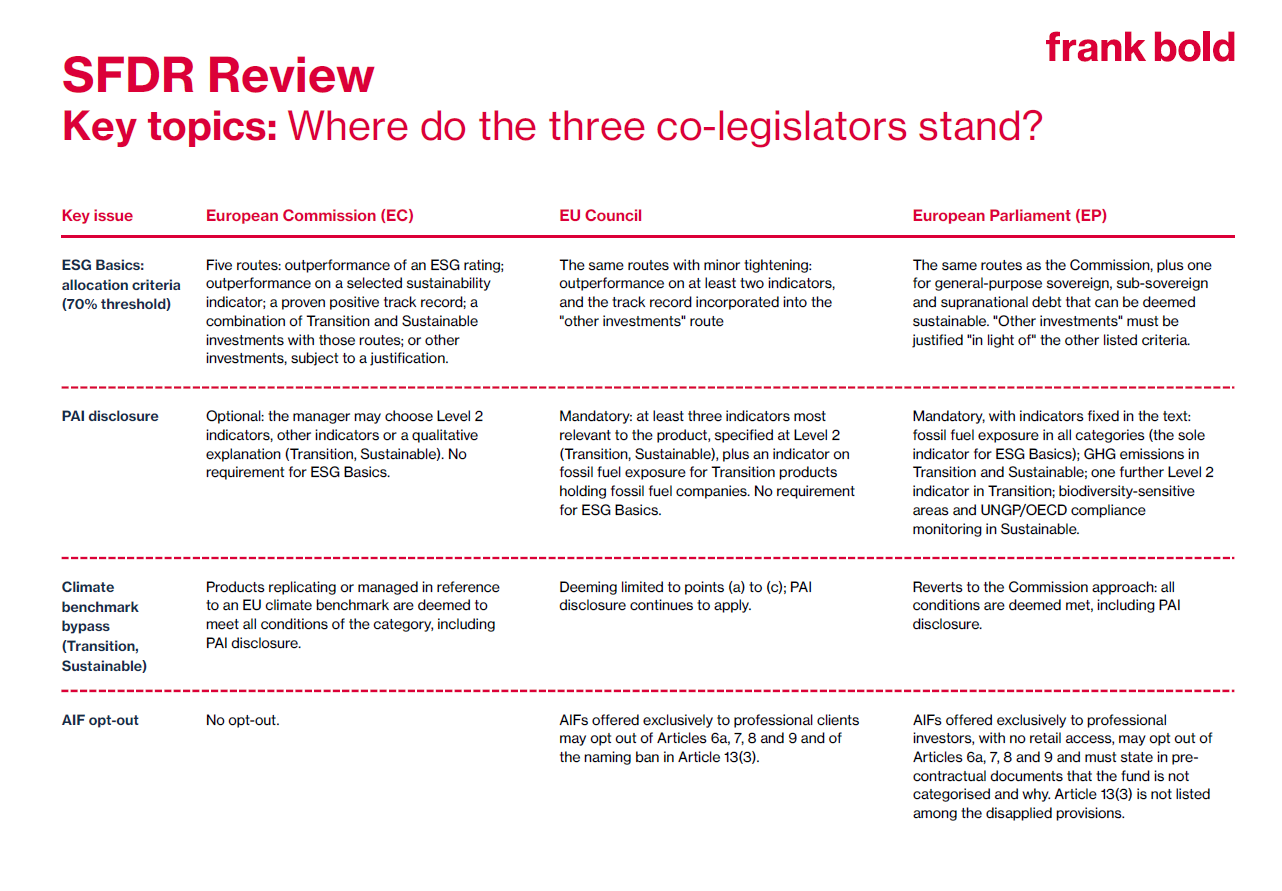
Parliament's text is the strongest of the three on most issues. Its main weakness is ESG Basics: retail investors receive a single indicator on fossil fuel exposure and little other information from which to assess performance, which risks perpetuating the catch-all character of Article 8 under SFDR 1.0.
Below, we set out our three priorities for the trilogue and the specific solutions we recommend to address them.
Parliament requires a single indicator for ESG Basics, exposure to the fossil fuel sector, and this must be retained. We ask that Parliament's own Transition wording be applied to Article 8, so that ESG Basics products report GHG emissions and fossil fuel exposure, together with one further indicator selected for relevance. This corresponds to the three indicators required by Council for Transition and Sustainable.
Council limits the effect of safe harbour to points (a) to (c) of the first subparagraph, so that PAI disclosure under point (d) continues to apply to products using the bypass. Parliament deems all conditions met. We ask the co-legislators to support the Council's scope.
The Commission proposal contains no opt-out, and we ask the co-legislators to maintain this position. If an opt-out is retained, Parliament's version is preferable to Council's, because it requires that no retail investor has access to the fund and requires a pre-contractual statement of non-categorisation.

The European Union is sending a clear signal: climate policy is no longer just an environmental vision. It is becoming a core pillar of economic strategy. The latest State of the Energy Union 2025 and Climate Action Progress Report 2025 confirm that competitiveness is now Brussels’ top priority. In this framework, decarbonisation is positioned as a tool to strengthen Europe’s technological sovereignty, stability, and energy affordability.
With the final revision of the CSRD landing only in mid-December, many companies spent 2025 navigating a moving goal post. Yet despite the uncertainty, some clear lessons have emerged from those already reporting under the new rules. So what did companies actually struggle with, and what did they take away from the experience?
Less than a week apart, the end of the year brought two developments in the case of the impact of the Turów mine on the environment in Czechia. Both developments are in line with the long-term efforts of Frank Bold experts to make information on the state of groundwater available and to mitigate the overall impact of mining.


