





We've compared the different positions of the European Commission, Council of the EU and the European Parliament on the review of the SFDR. Read below our recommendations for this trilogue.
Trilogue negotiations on the SFDR review are due to start on 22 October and envisioned to finish by the end of 2026.
Parliament's text is the strongest of the three on most issues. Its main weakness is ESG Basics: retail investors receive a single indicator on fossil fuel exposure and little other information from which to assess performance, which risks perpetuating the catch-all character of Article 8 under SFDR 1.0.
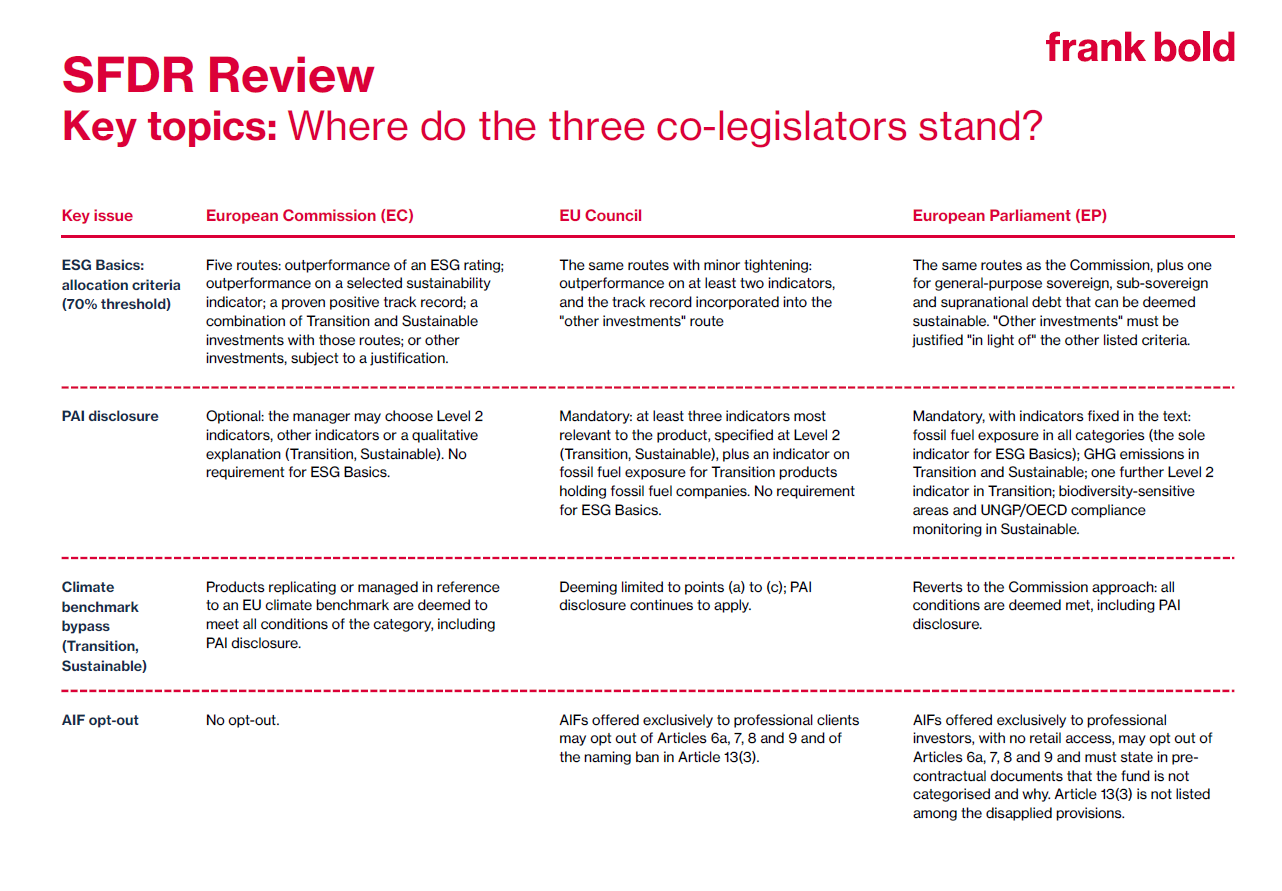
Below, we set out our three priorities for the trilogue and the specific solutions we recommend to address them.
Parliament requires a single indicator for ESG Basics, exposure to the fossil fuel sector, and this must be retained. We ask that Parliament's own Transition wording be applied to Article 8, so that ESG Basics products report GHG emissions and fossil fuel exposure, together with one further indicator selected for relevance. This corresponds to the three indicators required by Council for Transition and Sustainable.
Council limits the effect of safe harbour to points (a) to (c) of the first subparagraph, so that PAI disclosure under point (d) continues to apply to products using the bypass. Parliament deems all conditions met. We ask the co-legislators to support the Council's scope.
The Commission proposal contains no opt-out, and we ask the co-legislators to maintain this position. If an opt-out is retained, Parliament's version is preferable to Council's, because it requires that no retail investor has access to the fund and requires a pre-contractual statement of non-categorisation.

The Frank Bold Society and the Neighbourhood Association Uhelná called on the Czech government today to be more consistent in its negotiations with Poland over mining at the Turów brown coal mine. According to both organisations, the government did not have enough information or time to prepare an agreement that would truly protect Czech interests. Moreover, the government has acted in a non-transparent manner by failing to inform the public in advance of the terms of the agreement being prepared, which should lead to the withdrawal of the action against Poland at the EU Court of Justice. The organisations have therefore drawn up a document with seven basic demands on which the Czech side should insist.
The European Commission recently introduced a draft of the revised EU ETS Directive which, among other things, proposes that 100 % of ETS revenues should be used for environmental measures. We welcome this idea but we’re also sceptical about how the ETS revenues are used in the Czech Republic. Therefore, we have prepared an analysis mapping the use of ETS revenues in Czech Republic and sent it to the European Commission as an input for the recent public consultation. The main conclusions are presented below.
We have analysed hundreds of pages of technical documents and prepared a comprehensive overview of the sustainability reporting requirements under the forthcoming EU legislation. We summarise what ESG data will be critical for companies, banks, and investors in sustainability strategy and management and in the areas of climate change, environment, sustainable activities, employees and supply chains, due diligence, and anti-corruption measures.


