





We've compared the different positions of the European Commission, Council of the EU and the European Parliament on the review of the SFDR. Read below our recommendations for this trilogue.
Trilogue negotiations on the SFDR review are due to start on 22 October and envisioned to finish by the end of 2026.
Parliament's text is the strongest of the three on most issues. Its main weakness is ESG Basics: retail investors receive a single indicator on fossil fuel exposure and little other information from which to assess performance, which risks perpetuating the catch-all character of Article 8 under SFDR 1.0.
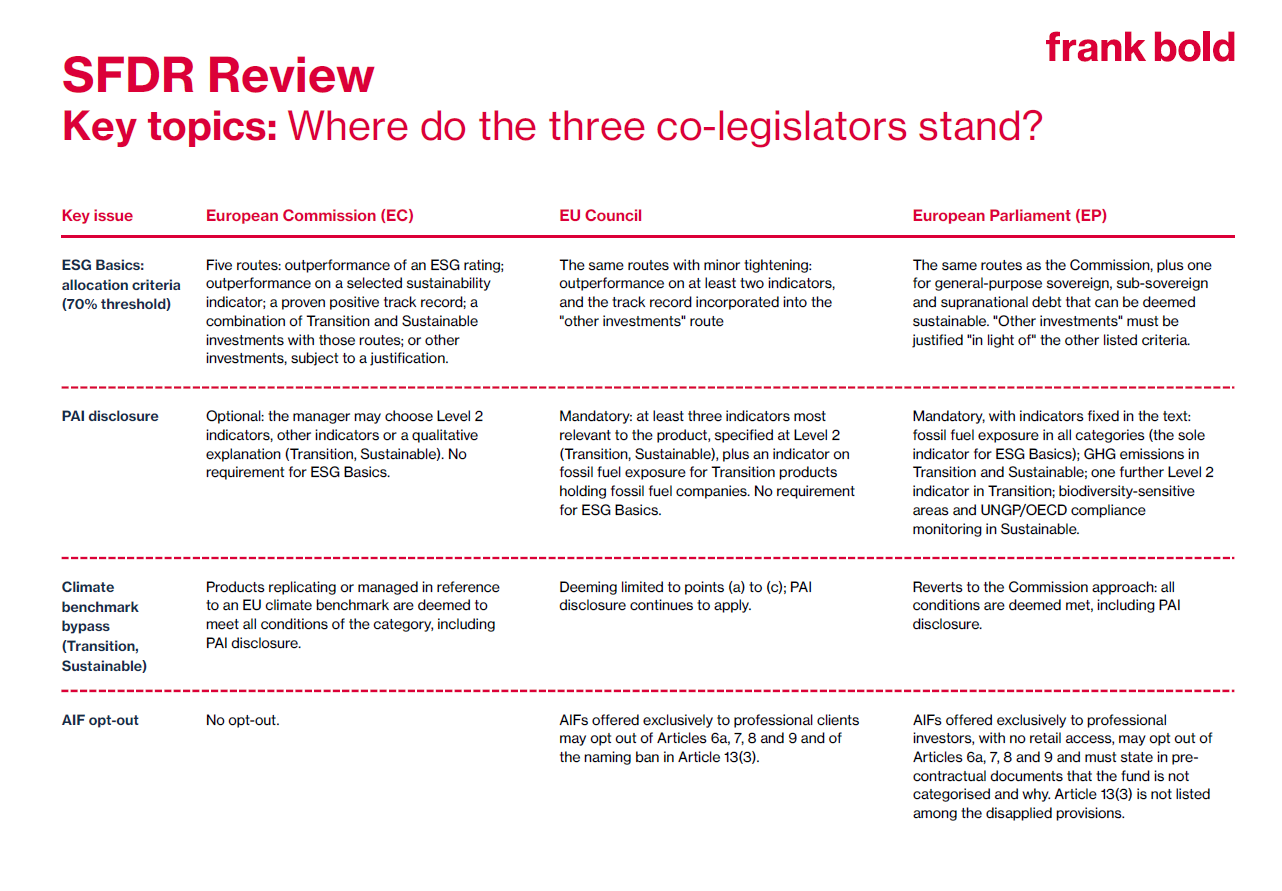
Below, we set out our three priorities for the trilogue and the specific solutions we recommend to address them.
Parliament requires a single indicator for ESG Basics, exposure to the fossil fuel sector, and this must be retained. We ask that Parliament's own Transition wording be applied to Article 8, so that ESG Basics products report GHG emissions and fossil fuel exposure, together with one further indicator selected for relevance. This corresponds to the three indicators required by Council for Transition and Sustainable.
Council limits the effect of safe harbour to points (a) to (c) of the first subparagraph, so that PAI disclosure under point (d) continues to apply to products using the bypass. Parliament deems all conditions met. We ask the co-legislators to support the Council's scope.
The Commission proposal contains no opt-out, and we ask the co-legislators to maintain this position. If an opt-out is retained, Parliament's version is preferable to Council's, because it requires that no retail investor has access to the fund and requires a pre-contractual statement of non-categorisation.

Frank Bold together with other leading NGOs working on corporate sustainability and sustainable finance raised strong concerns about the delay in the publication of the Sustainable Corporate Governance initiative, as well as the lack of information explaining such new delay.
Due diligence is a precondition for the sustainable activities as defined by the EU Taxonomy and green financing under the Sustainable Finance Disclosure Regulation, including green bonds. Particular ESG due diligence requirements will be regulated by the forthcoming Sustainable Corporate Governance Directive. To help companies better understand its scope and to clarify its requirements, Frank Bold is hosting a webinar. It will feature international experts from companies such as Ericsson and outdoor clothing manufacturer Vaude. We invite you to join us on 26 January at 10 am CET.
In mid-December, the European Commission acknowledged a large part of the arguments put forward by the Czechia in an effort to prevent the expansion and continuation of illegal mining at the Turów mine in Poland, that endangers the sources of drinking water for thousands of people in the Liberec region and, according to new studies, has serious impacts on groundwater in Germany as well. Frank Bold's lawyers, who defend the interests of Czech citizens, have long been involved in the case.


