





We've compared the different positions of the European Commission, Council of the EU and the European Parliament on the review of the SFDR. Read below our recommendations for this trilogue.
Trilogue negotiations on the SFDR review are due to start on 22 October and envisioned to finish by the end of 2026.
Parliament's text is the strongest of the three on most issues. Its main weakness is ESG Basics: retail investors receive a single indicator on fossil fuel exposure and little other information from which to assess performance, which risks perpetuating the catch-all character of Article 8 under SFDR 1.0.
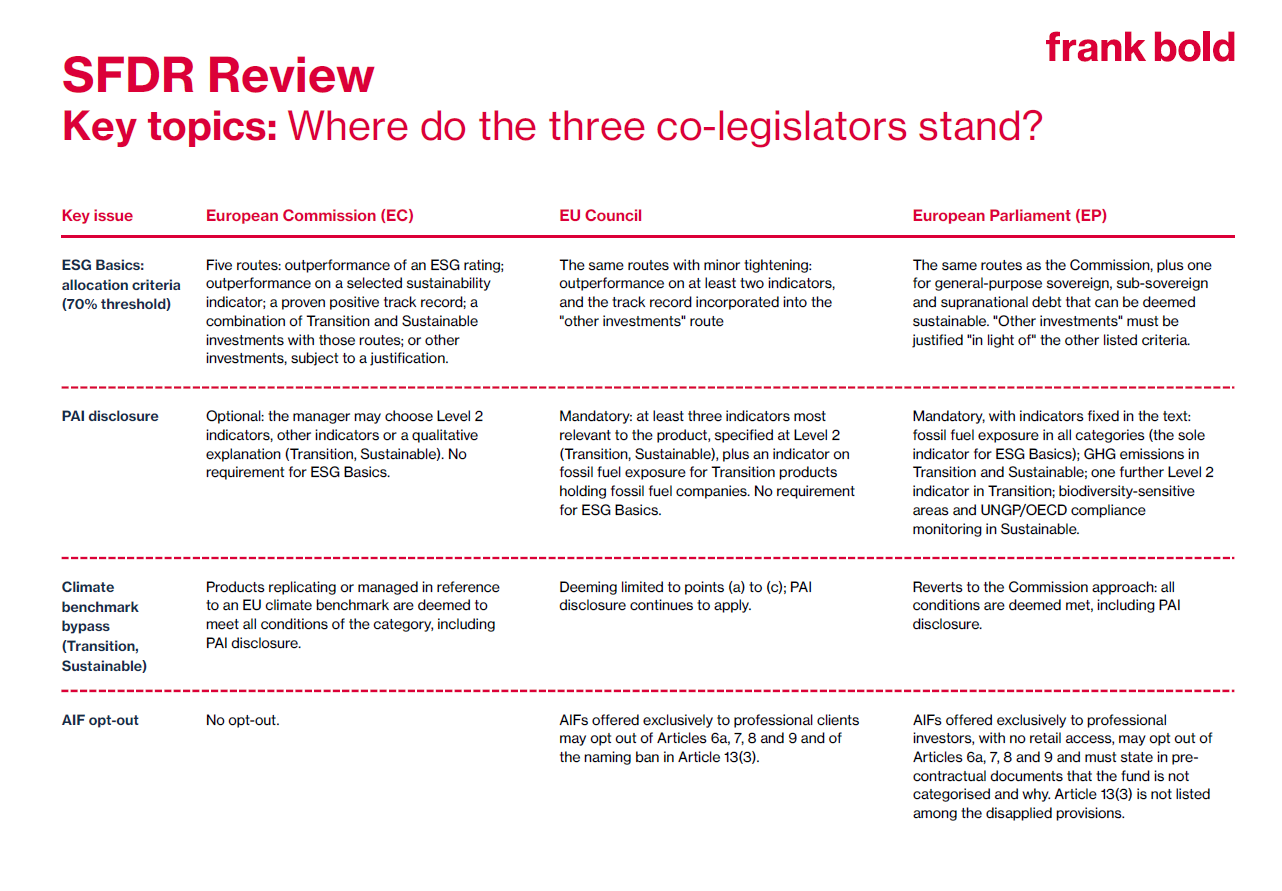
Below, we set out our three priorities for the trilogue and the specific solutions we recommend to address them.
Parliament requires a single indicator for ESG Basics, exposure to the fossil fuel sector, and this must be retained. We ask that Parliament's own Transition wording be applied to Article 8, so that ESG Basics products report GHG emissions and fossil fuel exposure, together with one further indicator selected for relevance. This corresponds to the three indicators required by Council for Transition and Sustainable.
Council limits the effect of safe harbour to points (a) to (c) of the first subparagraph, so that PAI disclosure under point (d) continues to apply to products using the bypass. Parliament deems all conditions met. We ask the co-legislators to support the Council's scope.
The Commission proposal contains no opt-out, and we ask the co-legislators to maintain this position. If an opt-out is retained, Parliament's version is preferable to Council's, because it requires that no retail investor has access to the fund and requires a pre-contractual statement of non-categorisation.

The expert group Frank Bold, along with Greenpeace and Friends of the Earth, has submitted a complaint to the European Commission regarding the actions of Czech authorities in setting emission limits for the Počerady coal power plant. In August 2024, a court revoked the plant's extensive emission limits derogation, and authorities were required to immediately reflect this decision in its operating permit. However, this has not yet happened. As a result, the power plant is currently violating the legal limit for mercury emissions. The complainants are calling on the Commission to investigate whether the Czech Republic’s approach to Počerady is in breach of the EU Industrial Emissions Directive (IED).
Domestic political opportunism and foreign anti-competitive pressure threaten to dismantle one of its biggest advantages. Read below a brief summary of our conference on sustainability and competitiveness held last January 2025 in Brussels.
Electricity sharing in Czechia represents a relatively recent but increasingly popular phenomenon. With the implementation of the regulatory framework that enables the formation of Energy Communities (ECs) starting in July 2024, 20 ECs have already been established. In addition, the law also activates the possibility of energy sharing by “an active consumer”. What does the existing regulatory framework entail, and what challenges does it encounter?


