





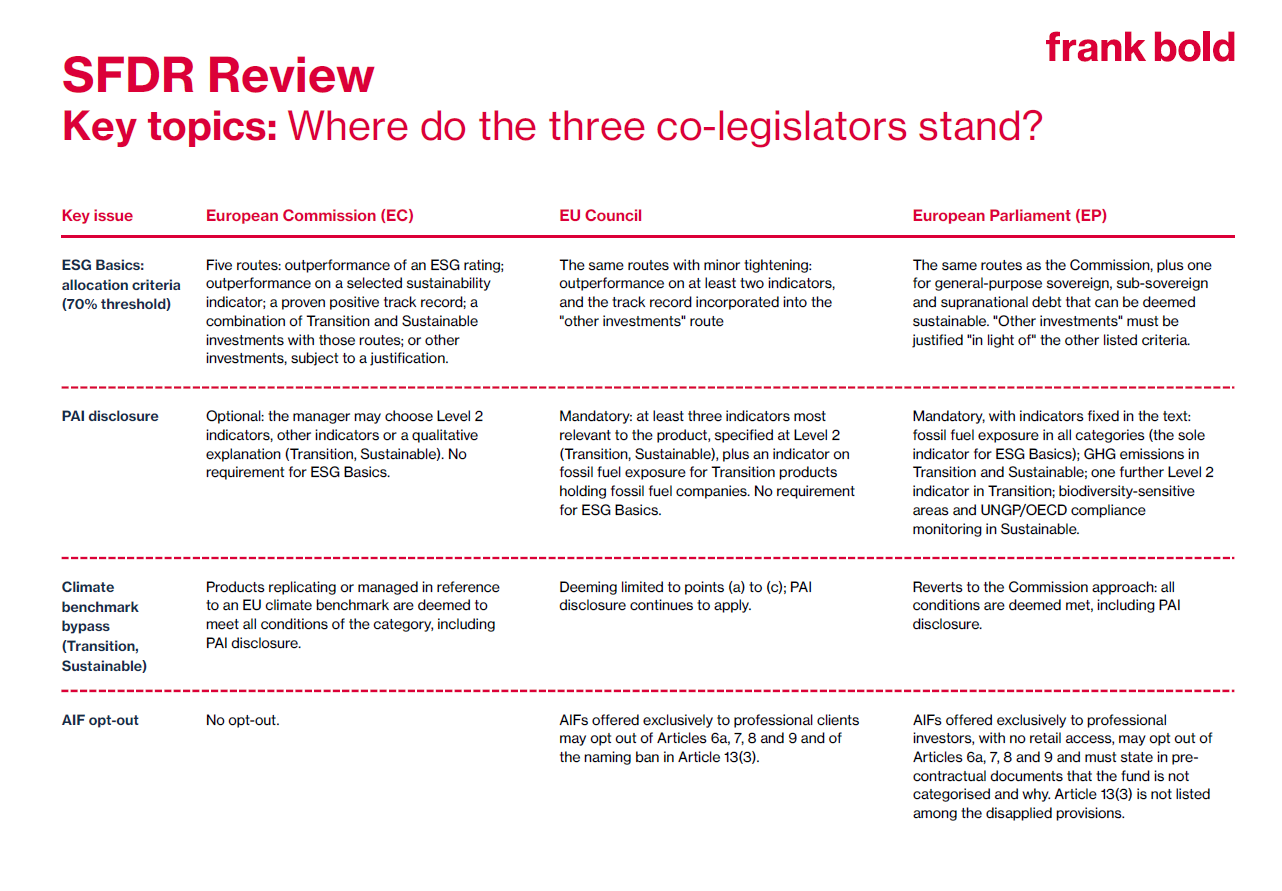
We've compared the different positions of the European Commission, Council of the EU and the European Parliament on the review of the SFDR. Read below our recommendations for this trilogue.
Trilogue negotiations on the SFDR review are due to start on 22 October and envisioned to finish by the end of 2026.
Parliament's text is the strongest of the three on most issues. Its main weakness is ESG Basics: retail investors receive a single indicator on fossil fuel exposure and little other information from which to assess performance, which risks perpetuating the catch-all character of Article 8 under SFDR 1.0.
Below, we set out our three priorities for the trilogue and the specific solutions we recommend to address them.
Parliament requires a single indicator for ESG Basics, exposure to the fossil fuel sector, and this must be retained. We ask that Parliament's own Transition wording be applied to Article 8, so that ESG Basics products report GHG emissions and fossil fuel exposure, together with one further indicator selected for relevance. This corresponds to the three indicators required by Council for Transition and Sustainable.
Council limits the effect of safe harbour to points (a) to (c) of the first subparagraph, so that PAI disclosure under point (d) continues to apply to products using the bypass. Parliament deems all conditions met. We ask the co-legislators to support the Council's scope.
The Commission proposal contains no opt-out, and we ask the co-legislators to maintain this position. If an opt-out is retained, Parliament's version is preferable to Council's, because it requires that no retail investor has access to the fund and requires a pre-contractual statement of non-categorisation.

Local groups and NGOs including Frank Bold, that is very active in the process, welcomed the Czech government’s decision to file a lawsuit at the European Court of Justice against the Polish government for the illegal operation of the Turów lignite coal mine, which has been dug right up to the Czech and German borders, damaging local water supplies for nearby communities. This is the first such legal case for the Czech Republic and the first in EU’s history where one member state sues another for environmental reasons.
Meeting the goal of the European Green Deal to achieve no net GHG emissions by 2050 requires at least half trillion euros of additional investments in the EU every year and will involve significant market and regulatory changes targeting every sector of the economy. This will profoundly change how companies and their directors need to integrate sustainability concerns in their strategies and business decisions.
Frank Bold organised two online events to present the results of the research on the disclosures made by 300 companies on climate and environmental matters providing targeted presentation and insights for companies in Southern Europe and Central and Eastern Europe.


