





We've compared the different positions of the European Commission, Council of the EU and the European Parliament on the review of the SFDR. Read below our recommendations for this trilogue.
Trilogue negotiations on the SFDR review are due to start on 22 October and envisioned to finish by the end of 2026.
Parliament's text is the strongest of the three on most issues. Its main weakness is ESG Basics: retail investors receive a single indicator on fossil fuel exposure and little other information from which to assess performance, which risks perpetuating the catch-all character of Article 8 under SFDR 1.0.
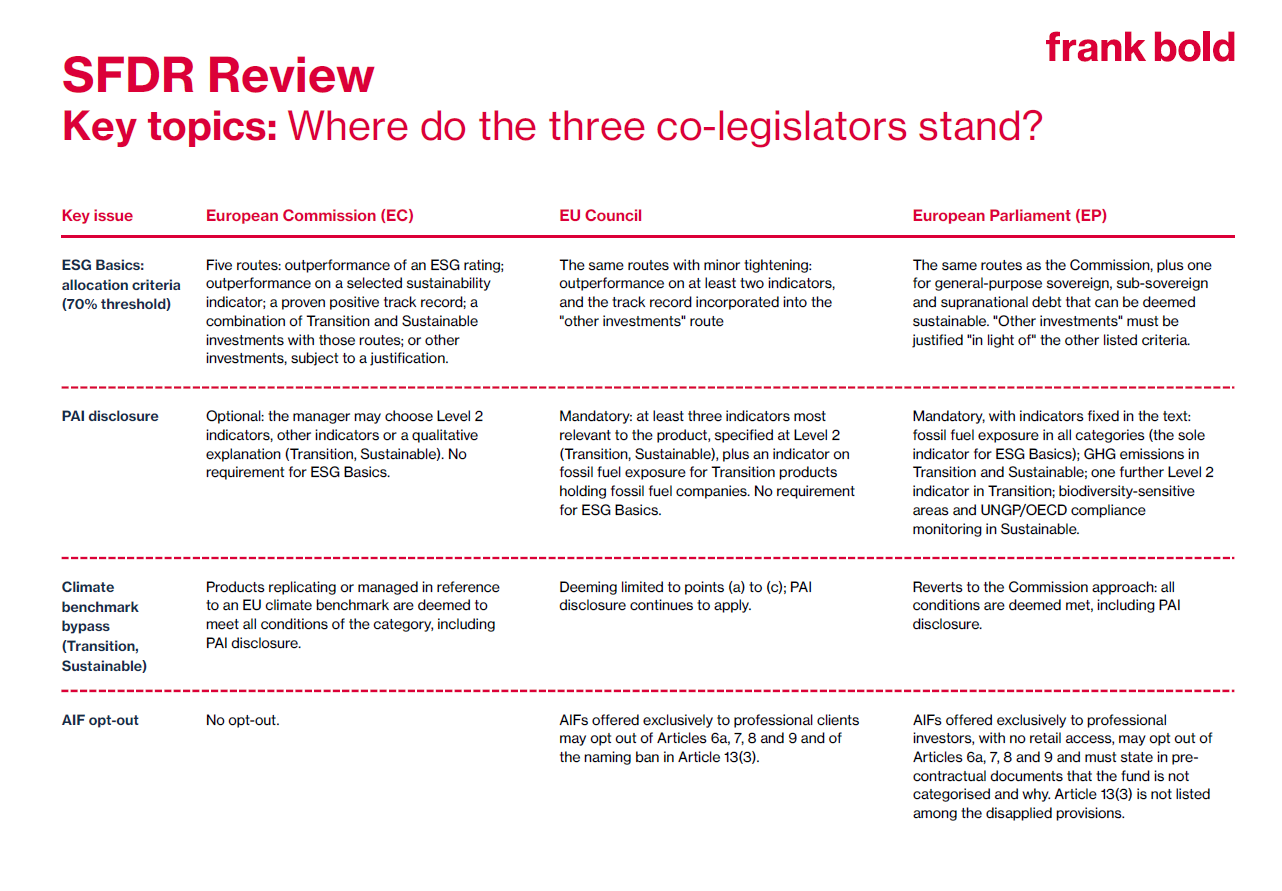
Below, we set out our three priorities for the trilogue and the specific solutions we recommend to address them.
Parliament requires a single indicator for ESG Basics, exposure to the fossil fuel sector, and this must be retained. We ask that Parliament's own Transition wording be applied to Article 8, so that ESG Basics products report GHG emissions and fossil fuel exposure, together with one further indicator selected for relevance. This corresponds to the three indicators required by Council for Transition and Sustainable.
Council limits the effect of safe harbour to points (a) to (c) of the first subparagraph, so that PAI disclosure under point (d) continues to apply to products using the bypass. Parliament deems all conditions met. We ask the co-legislators to support the Council's scope.
The Commission proposal contains no opt-out, and we ask the co-legislators to maintain this position. If an opt-out is retained, Parliament's version is preferable to Council's, because it requires that no retail investor has access to the fund and requires a pre-contractual statement of non-categorisation.

In the context of the last phase of the negotiations on the Corporate Sustainability Due Diligence Directive (CSDDD), Frank Bold initiated a multistakeholder statement together with the Responsible Business Alliance (RBA) and Shift.
Today, the European Parliament successfully fended off efforts to reject the European Sustainability Reporting Standards (ESRS), a key legislative piece to ensure the effective application of the Corporate Sustainability Reporting Directive (CSRD) and the transitioning efforts in the context of the Green Deal. A majority of 359 Members of the Parliament voted against a motion to reject the ESRS and its replacement with an emptied and diluted piece of legislation.
In light of today’s State of the Union Address by President von der Leyen and the ‘SME relief package’ presented by the European Commission yesterday, Frank Bold calls on the Commission not to disregard the political agreement reached in 2022 on the Corporate Sustainability Reporting Directive (CSRD).


