





After one year of rushed and frenzied political decision-making on the Omnibus 1 package, the EU has come to a decision.
An agreement between the co-legislators was found on Monday night under the Danish Presidency. The deal needs to be rubber-stamped in the next few days in the EU Parliament, where the EPP has allied with far-right groups to negotiate and water down the EU sustainability and due diligence laws.
These are the same groups publicly aligning with Trump - while staying silent when U.S policies threaten the bloc’s interests.
Julia Otten of Frank Bold said:
“The final Omnibus agreement reflects short-sighted political decision-making, forced through with the far-right, at a time where the EU needs to stand firm and speed up the transition for its own strategic interests. By deleting the climate transition plan implementation, the EU is weakening the key legislative frameworks for businesses to prepare for climate risks and global challenges that can severely affect their operations and value chains. This is counter-productive for businesses, weakens accountability, and jeopardises the EU's own plans and objectives on climate and the industrial transition."
Sustainability has been dangerously reduced to an add-on by the EU lawmakers after coordinated efforts from foreign powers who saw the potential impacts of the laws at stake. The US administration fought against the laws, particularly the CSDDD, and major US companies, particularly from the oil and gas sector, mobilised other countries to join that opposition against the EU Green Deal Agenda and EU’s energy independence and clean tech leadership.
The US’ strategy document published this week clearly spells out their aim of “cultivating resistance to Europe’s current trajectory within European nations”. Few in the EU Commission spoke up against this overarching policy, such as Commissioner Ribera: “Europe can and must simplify rules where necessary, reduce unnecessary burdens and improve consistency. But giving up on transparency, reliability and diligence — or outsourcing core elements of our transition — is not simplification. It is self-harm." Instead, EU President von der Leyen (EPP) opened pandora’s box on this first Omnibus and allowed the climate change deniers and Trump-admirers of the far-right in the EU Parliament to team up with the EPP and re-write an essential part of the Green Deal.
The EU is now left with a sustainability framework that is reduced to the bare minimum, depriving the market of its effects at scale and reducing corporate accountability for major environmental and human rights impacts.
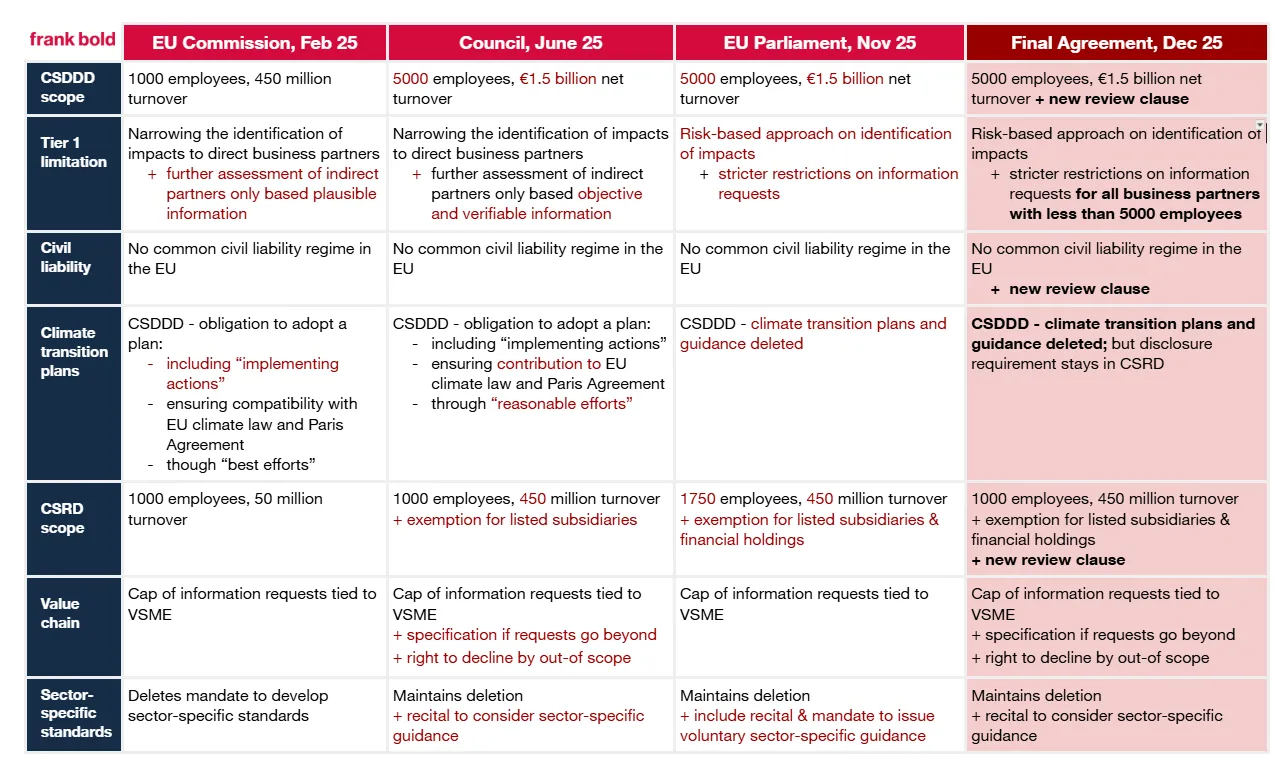
After more than a decade of progress, the EU Commission decided to skip all due process (see the EU Ombudswoman’s findings) and present changes with massive implications for businesses across the EU. The Council and the EU Parliament agreed last night to the following modifications:
What is the purpose of sustainability reporting: it helps companies identify impacts, risks and opportunities connected to their business model and supply chains. This process provides critical insights to business leaders to prepare their strategies, development and enhance long-term competitiveness in a low-carbon, resource-efficient economy. By providing structured, comparable, and relevant ESG data, companies can gain a competitive advantage over those lagging behind, and attract more investments (e.g. from pension funds, ESG focused products or indices) and improve their chances in public procurement procurement– as most national and EU funding schemes incorporate green or social requirements.
What is the purpose of environmental and human rights due diligence: Due diligence is the basis for good reporting on risks and impacts. It gives companies the tool for effective risk management and engagement with suppliers to foster resilient and reliable relationships in global value chains. It also enhances accountability of companies and introduces complaint mechanisms at company level and public enforcement, including sanctions for non-compliance. It therefore sets a common standard for all companies active in the EU market and prevent foreign companies from China or the US to undercut those social and environmental standards.
By upholding and implementing sustainability reporting and due diligence, European businesses can still reduce risks connected with costly and volatile energy imports and position themselves as global leaders in strategic markets such as the clean tech sector.

With trilogue negotiations on the SFDR review due to start on October 22, we take a closer look at the European Parliament's, the strongest position of the three co-legislators texts.
We analysed the 2025 reports of 100 large EU companies disclosing sustainability information under the Corporate Sustainability Reporting Directive (CSRD) to assess how companies are addressing critical sustainability challenges in their strategy.
A new joint publication with Client Earth on the Corporate Sustainability Due Diligence Directive helps EU Members states prepare for a meaningful transposition, ahead of the European Commission's expected implementation guidelines for the Directive next year.


