

Is China making its green stride forward? Listen to Chief Economist and Bruegel Senior Fellow, Alicia García-Herrero.
.webp)
As the world faces the dual challenges of addressing climate change and navigating geopolitical tensions, cooperation on climate goals is under threat. China’s role in green technology has made it a vital player, but it is also increasingly seen as a rival, or even a threat, by other global powers.
Electric vehicles (EVs) have become the latest flashpoint, with the United States and European Union imposing punitive tariffs on Chinese EV imports, intensifying trade disputes.
This week on the podcast, Richard Howitt speaks with Alicia Garcia Herrero, chief economist for Asia Pacific at Natixis and Senior Fellow at Bruegel, joining from Hong Kong. Drawing on her extensive expertise, Alicia discusses how the EU can navigate its growing reliance on Chinese green tech and craft a competitive industrial strategy.
You will hear more about:
"The EU needs to be loud and clear as to what they are offering. We need to realize that this needs to be done under a different hat: one of partnership, one where everybody has the same say. And that's very different from China. China has a hub and spoke approach. China is at the center and talks to everybody, but nobody talks to each other. If we don’t try to show that what we offer is more encompassing or perhaps even more rewarding in terms of job creation and welfare creation for these countries, then it is a lost battle."


How is the Corporate Sustainability Reporting Directive (CSRD) playing out in practice and what lessons can be learned? Listen to Frank Bold’s own Sustainability Researcher Lorena Bisignano, and Filip Gregor, Head of Responsible Companies and member of EFRAG’s SRB.
.png)
What do China’s new supply chain security and counter-extraterritoriality rules mean for European companies trying to conduct human rights and environmental due diligence? Listen to Katja Drinhausen, Head of Programme Politics and Society at the Mercator Institute for China Studies (MERICS).
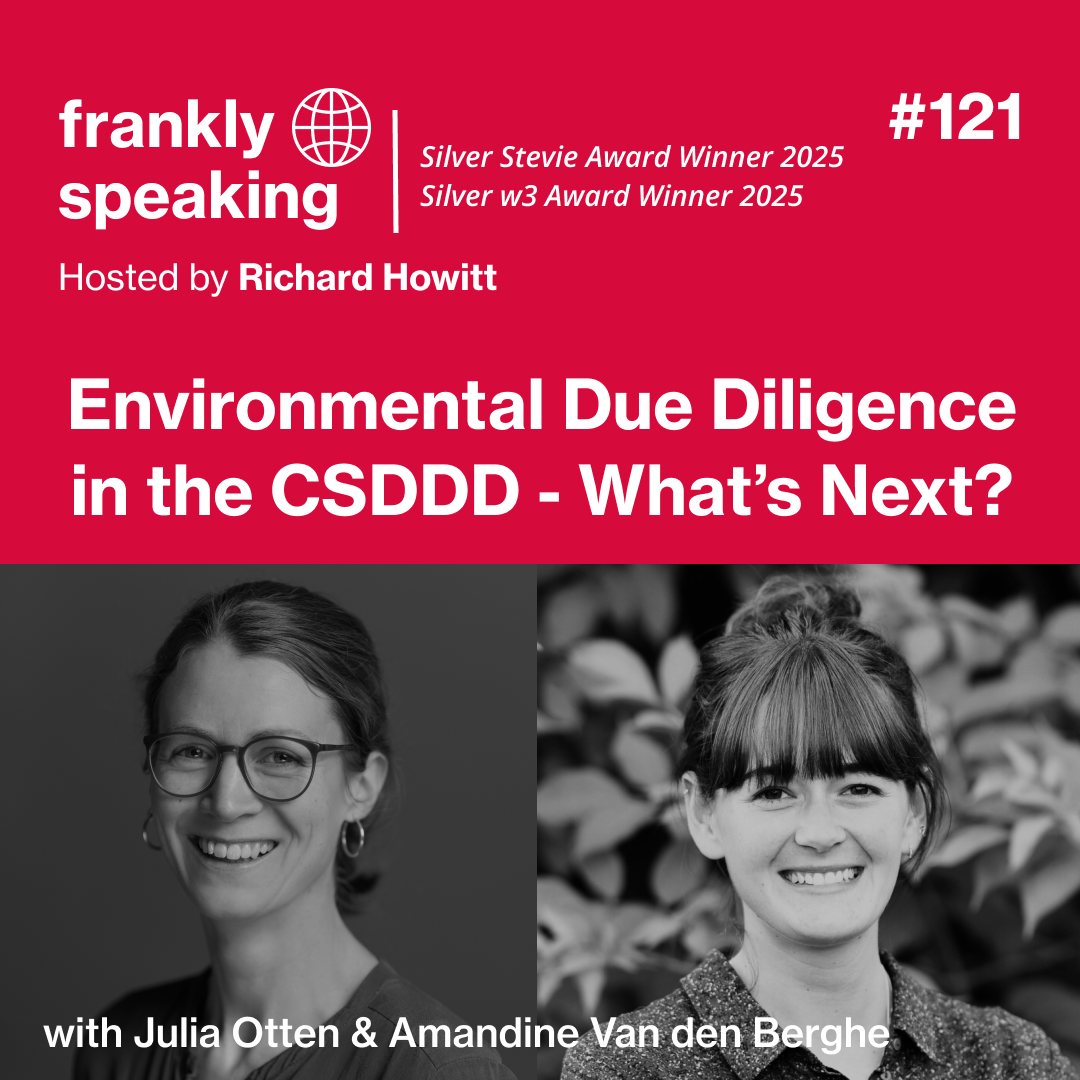
What does meaningful implementation of the Corporate Sustainability Due Diligence Directive look like in practice? Listen to Julia Otten, Senior Policy Officer at Frank Bold, and Amandine Van Den Berghe, Senior Lawyer specialising in value chains, trade and investment at ClientEarth.


