


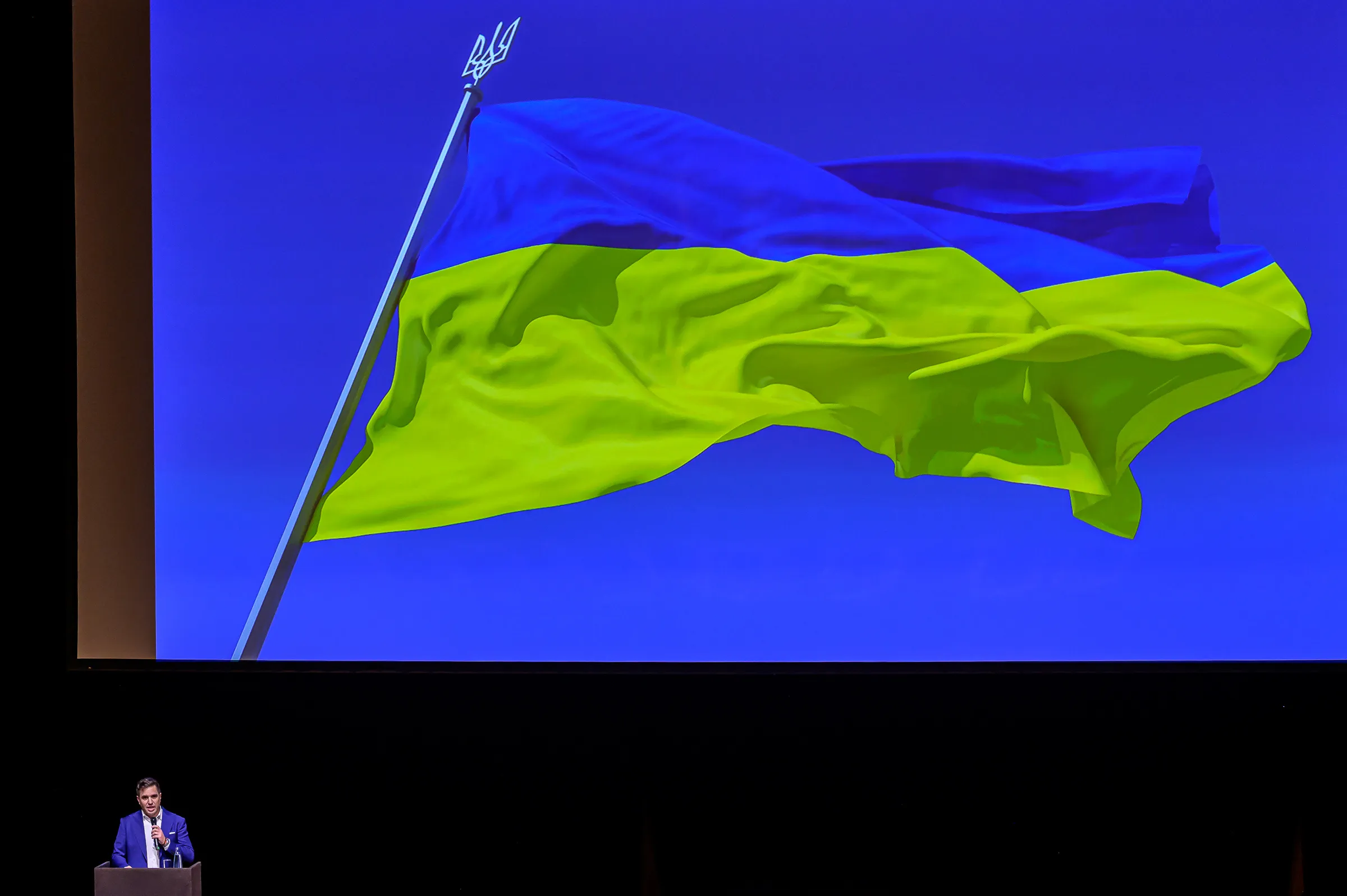


The Frank Bold expert group continues its long-term support for Ukraine in 2026. As the fourth year of Russian aggression draws to a close, Frank Bold is sending another financial contribution to support the country’s defenders through the Ukrainian foundation Come Back Alive.
Frank Bold has been regularly involved in assistance to Ukraine for the past four years, ever since the country faced armed aggression from Russia in February 2022. This year, the organisation is donating CZK 200,000 to support Ukraine. In total, since 2022, the expert group has provided CZK 850,000 to help the waraffected country.
“Solidarity and perseverance matter. We believe it is important not to leave Ukrainians alone in this difficult time. We are convinced that even smaller but regular contributions can, over the years, become a significant source of support. At the same time, we hope that this may inspire other Czech companies of a similar size,” said Pavel Franc, CEO of Frank Bold.
At the beginning of the war, Frank Bold provided support through Post Bellum and later directly supported the special unit Perun. Now repeatedly the contribution from Frank Bold is heading to the Ukrainian foundation Come Back Alive. “We are confident that through them, the assistance reaches directly those defending the country and its people: those who have been protecting their freedom for four years now — at the front lines, in trenches, and in the background. This is our way of contributing to ensuring that freedom and democracy do not fall to a stronger aggressor,” added Pavel Franc.
“It is important to remember, that over 80 % of the personnel in the Ukrainian defence are civilians who decided to step up and protect us all from further russian aggression. That’s why, by providing defence support, I believe that we do a humanitarian support, as each khyvnia or krona is invested to save lives,” confirmed Kateryna Leschyshyn, Head of International Partnerships at the Come Back Alive Foundation.
Her words are echoed by the story of Ukrainian human rights lawyer Ihor Konopka. In the autumn of 2021, he joined Frank Bold as an analyst focusing on sustainable business and related legislation. Just over a month after the war began, he went, as he says, on “military leave” to join the Ukrainian army.
“I have met lots of different people in the army. Most of them former civilians: from drivers to business owners, from barbers to doctors, from electricians to IT-specialists. And yet, once in the army – despite our differences – we were all doing our best to help our country and survive this terrible war,” remembers Ihor Konopka.
Upon completing retraining for officers in reserve, Ihor was assigned to an air defense unit of the Ground Forces. There he served as Deputy Company Commander for Moral and Psychological Support, frequently taking shifts as Duty Officer, and later as Senior Assistant to the Chief of Staff for Personnel. In early 2025, Ihor was transferred to one of the Ministry of Defense units working on digital transformation, where he currently serves as a Personnel Management Officer.
It was Ihor who inspired his colleagues to direct Frank Bold’s support to Come Back Alive. “I believe international support for Ukraine, especially in the first years of the full-scale war, was absolutely crucial for our ability to stay strong and fight back. What inspires me the most is that such support comes not only from the governments, but from communities, private individuals and companies, or rather responsible companies,” said Ihor Konopka.
.webp)
According to the organisation’s statistics, Frank Bold is among several dozen foreign companies that provide regular financial support to Come Back Alive.
“From one side, it sounds like there are not too many foreign companies. From the other side, the fact that many foreign companies continue dealing with the root cause problem — russian armed invasion — means, we have a lot of strategic partners. And this gives us motivation to move forward,” Kateryna Leschyshyn emphasized, noting that some time ago Frank Bold organised an online discussion for its employees with one of Come Back Alive’s representatives.

One of the largest and bestknown Ukrainian nonprofit organizations supporting the Ukrainian army, Come Back Alive uses donations to purchase and deliver vehicles, optics, power and communications equipment, and intelligence technology — including unmanned aerial systems.
The organization has been active since 2014, when it secured and delivered the first bulletproof vests to the frontline, marked with the iconic slogan “Come back alive.” The motto later became the organization’s official name.
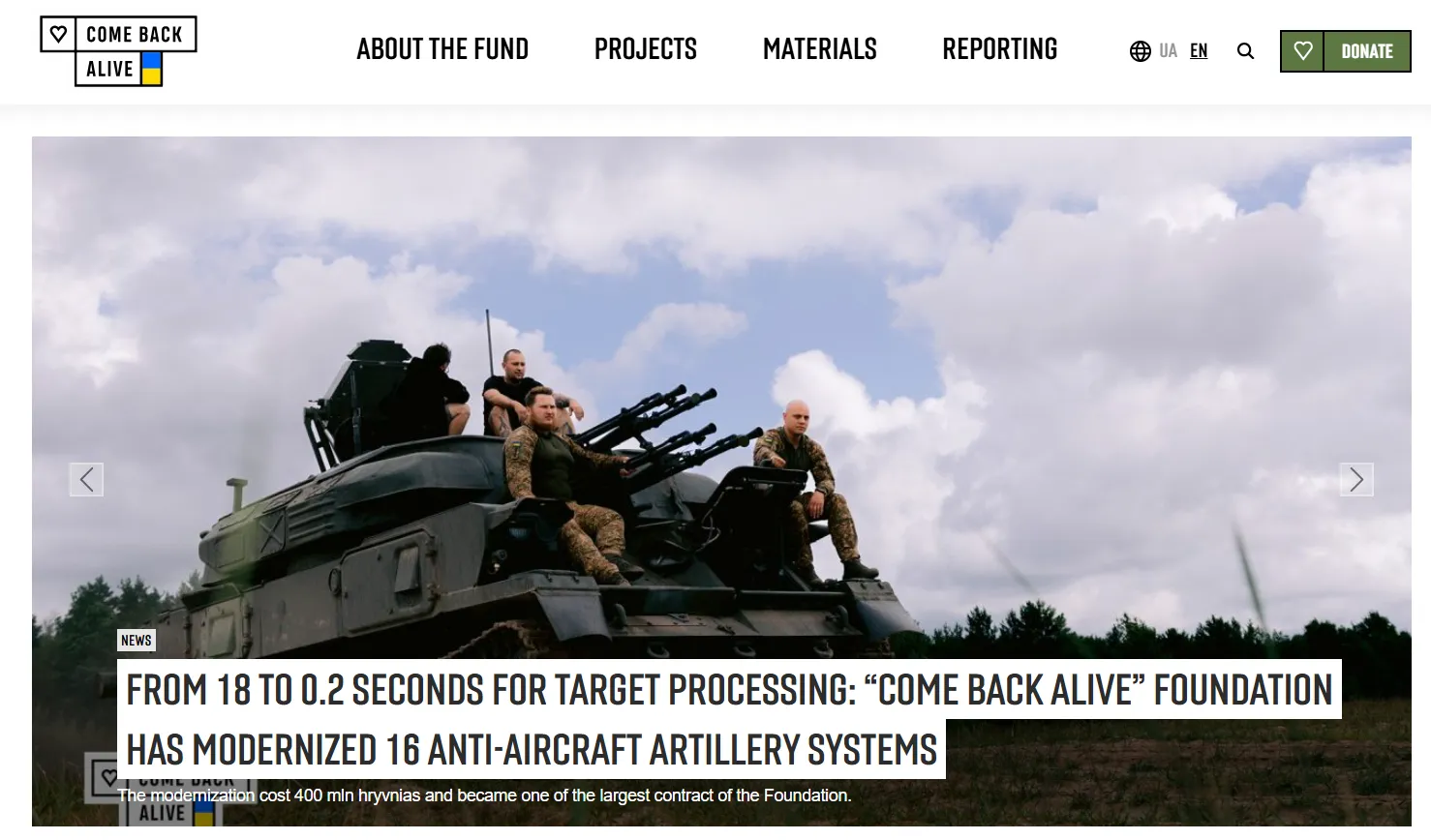
Currently, the foundation focuses on equipping the Ukrainian Armed Forces, as well as providing training and support for soldiers. It established and operates the Yatagan school for specialists in unmanned aerial systems, where drone pilots are trained. In the future, the school is expected to accommodate up to 3,000 specialists per year. Recently, the organization invested 400 million hryvnia (CZK 190 million) into modernizing 16 antiaircraft artillery systems.
Last year, Come Back Alive underwent an international management audit (ISO 9001:2015, Quality Management Systems), which confirmed that all phases of its activities — from fundraising to the delivery of assistance — are transparent, documented, and controlled. “This is the foundation of trust, without which longterm support for the country in wartime would not be possible,” the organization stated on its website.
While people and companies in the Czech Republic had donated up to 4 million CZK annually over the past four years, contributions have surged since January 2026 — reaching a record 29 million CZK in less than two months.
.webp)

A new joint publication with Client Earth on the Corporate Sustainability Due Diligence Directive helps EU Members states prepare for a meaningful transposition, ahead of the European Commission's expected implementation guidelines for the Directive next year.
EFRAG’s public consultation on the ESRS 40a (reporting standard for non-EU companies) marks a crucial moment for those working on corporate sustainability and accountability to send a clear signal to the EU on what direction to take. What is at stake is nothing less than Europe's international standing and authority, derived in part from its vision of a world where respect for human rights and the planet is a non-negotiable.
Read our just-released up-to-date briefing covering key EU sustainability law, including what has changed in the EU with the Omnibus reforms and what it means for businesses.


